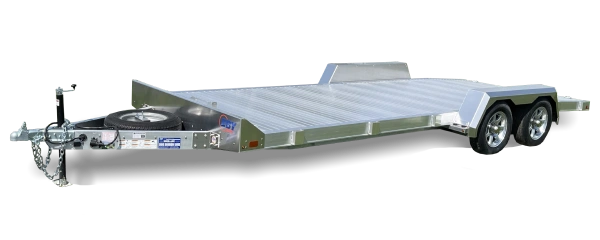
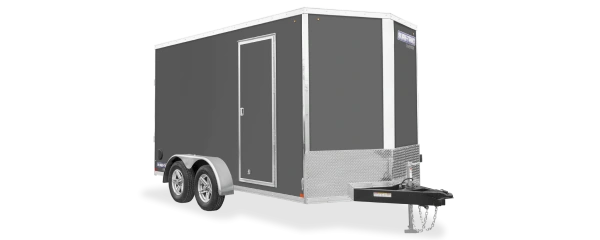
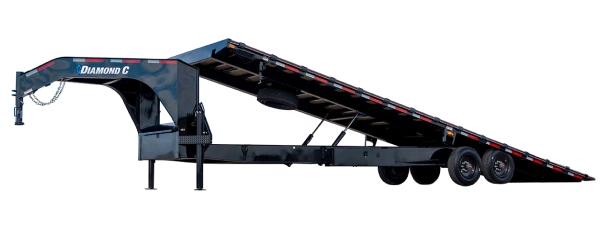
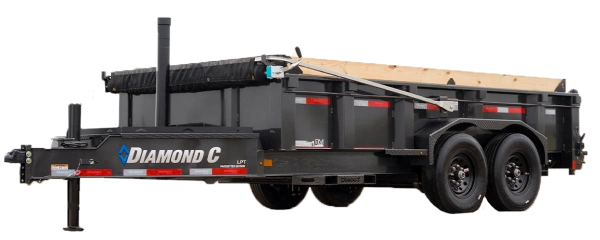








Choosing the right utility trailer starts with a simple question: What are you planning to haul?
It sounds straightforward, but trailer size involves more than deciding whether you need a 10-foot, 12-foot, or 16-foot trailer. You also need to consider the weight of your cargo, trailer width, axle capacity, towing vehicle, loading method, and whether your needs might change in the future.
Buying too small can limit what you can haul. Buying much more trailer than you need can add unnecessary weight and cost.
This guide will help you determine what size utility trailer makes sense for your truck, equipment, and everyday hauling needs.
Start With What You're Hauling
Before comparing trailers, make a list of the equipment and materials you expect to haul most often.
Common utility trailer loads include:
- Zero-turn and riding lawn mowers
- ATVs and UTVs
- Landscaping equipment
- Building materials
- Furniture and appliances
- Compact tractors
- Small equipment and attachments
- Brush, limbs, and property-maintenance supplies
- Tools and contractor equipment
Measure the length and width of your largest equipment and determine its approximate operating weight.
Don't forget attachments. A tractor with a loader or a mower with additional equipment may require considerably more deck space than the machine itself.
It's usually smart to leave some extra room rather than choosing a trailer that barely fits your current equipment.
Common Utility Trailer Sizes
Utility trailers come in many configurations, but a few sizes are especially common.
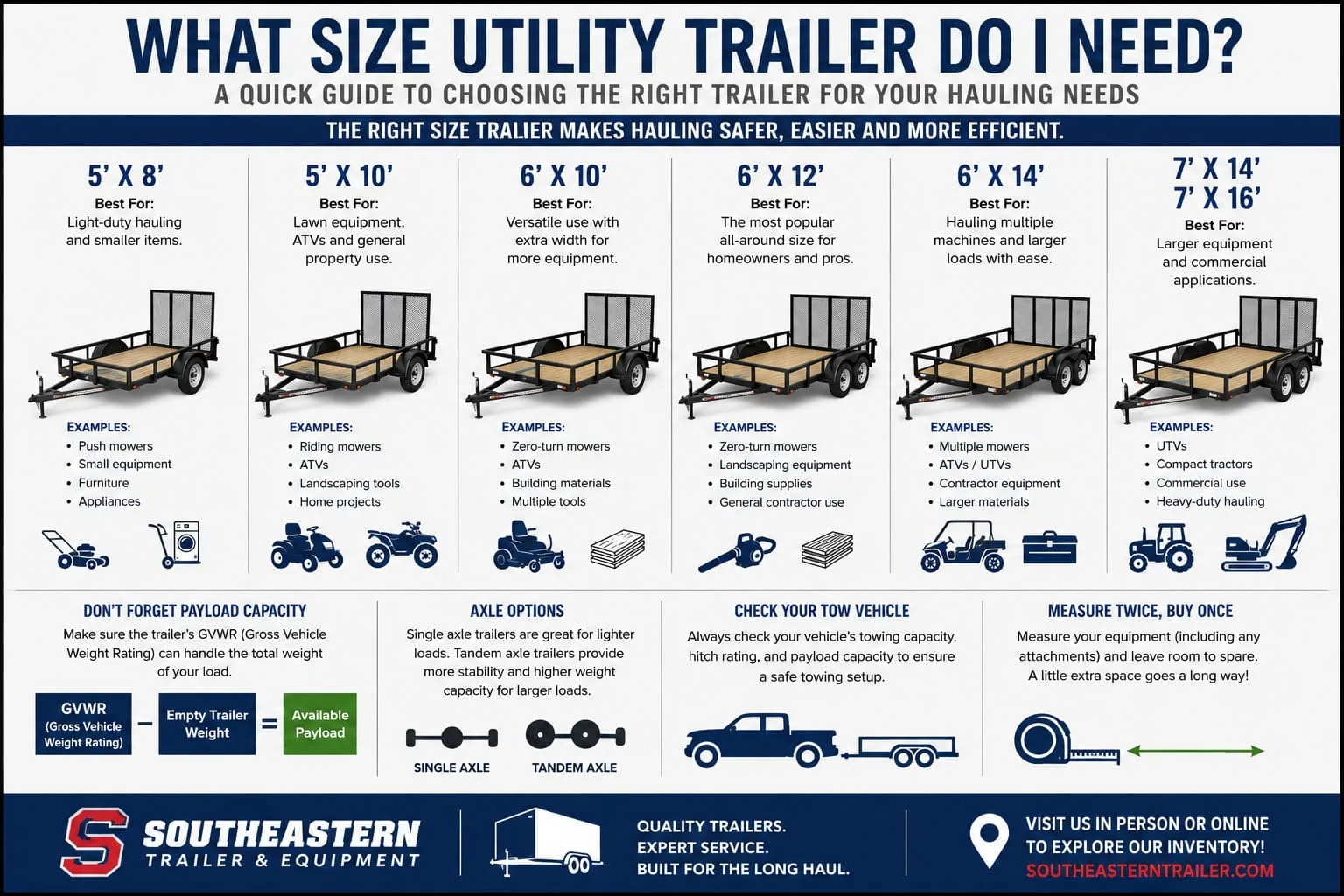
5x8 Utility Trailer
A 5x8 is a compact option that's easy to store and maneuver.
It can work well for:
- Push mowers
- Small lawn equipment
- Furniture
- Appliances
- Light household projects
- Occasional trips to the hardware store
A 5x8 can be a great choice when you need additional hauling capacity without moving into a larger trailer.
5x10 Utility Trailer
Moving up to a 5x10 provides additional deck space while remaining relatively compact.
Common uses include:
- Riding mowers
- Landscaping tools
- Small ATVs
- Home improvement materials
- Property maintenance
For homeowners who regularly need a trailer but aren't hauling large equipment, this can be a practical size.
6x10 or 6x12 Utility Trailer
A 6-foot-wide trailer gives you noticeably more usable space.
A 6x12 is especially versatile for:
- Zero-turn mowers
- ATVs
- Landscaping equipment
- Building supplies
- Multiple pieces of lawn equipment
- General contractor use
For many homeowners, landscapers, and property owners, the 6x12 utility trailer is a strong all-around choice.
6x14 Utility Trailer
The extra two feet may not sound significant, but it can make a big difference when you're carrying multiple machines or longer equipment.
A 6x14 can be a good fit for:
- Landscaping businesses
- Multiple mowers
- ATVs and recreational equipment
- Contractor equipment
- Larger property-maintenance setups
It also provides more flexibility if your equipment changes later.
7x14 and 7x16 Utility Trailers
If you're hauling larger equipment or need more usable deck space, stepping up to a 7-foot-wide trailer can make loading and positioning equipment easier.
These sizes are commonly considered for:
- Commercial landscaping
- Multiple zero-turn mowers
- UTVs
- Compact tractors
- Contractor equipment
- Larger loads of materials
At this point, however, payload capacity becomes just as important as trailer dimensions.
Trailer Size Isn't Just About Length and Width
One of the biggest mistakes trailer buyers make is choosing a trailer based only on whether their equipment physically fits.
A trailer can be large enough for your machine but still not have enough payload capacity to legally and safely carry it.
That's why you need to understand GVWR and payload.
What Is GVWR?
GVWR stands for Gross Vehicle Weight Rating. It represents the maximum allowable loaded weight of the trailer, including the trailer itself and its cargo.
Payload capacity is generally calculated as:
GVWR – Empty Trailer Weight = Available Payload
For example, suppose a trailer has:
- 7,000-lb. GVWR
- 2,000-lb. empty weight
That leaves approximately:
- 5,000 lbs. of payload capacity
Your equipment, attachments, tools, fuel, and anything else loaded onto the trailer all contribute to that weight.
Always verify the manufacturer's specifications for the particular trailer you're considering rather than relying on a general estimate.
Single Axle or Tandem Axle?
Trailer size often goes hand-in-hand with axle configuration.
Single-Axle Utility Trailers
Single-axle trailers are typically lighter, more maneuverable, and well suited to lighter loads.
They can make sense for:
- Homeowners
- Lawn equipment
- Small ATVs
- Light property maintenance
- Occasional hauling
Tandem-Axle Utility Trailers
A tandem-axle trailer uses two axles and is generally better suited for larger trailers and heavier loads.
Advantages can include:
- Greater load capacity
- Better stability
- Improved handling with heavier cargo
- More versatility for commercial equipment
If you're regularly hauling zero-turn mowers, multiple pieces of equipment, or heavier machinery, a tandem-axle trailer may be worth considering.
What Size Trailer Do I Need for a Zero-Turn Mower?
Start by measuring your mower's overall width and length.
Don't rely only on the advertised cutting-deck size. The mower's actual outside dimensions may be larger.
For one zero-turn mower, a 6x10 or 6x12 utility trailer may provide enough room in many situations.
If you're carrying two mowers, fuel cans, blowers, trimmers, and other landscaping equipment, you may want to consider a 6x14, 7x14, or 7x16, depending on the size and weight of your equipment.
Commercial landscapers should think beyond today's equipment. Leaving additional deck space can make it easier to expand your setup later.
What Size Trailer Do I Need for an ATV or UTV?
ATVs can often fit comfortably on smaller utility trailers, but UTVs generally require more room.
Before buying, measure:
- Overall vehicle length
- Overall width
- Vehicle weight
- Any added accessories
Pay particular attention to width. Larger side-by-sides can require a wider trailer than buyers initially expect.
Also consider how you'll secure the vehicle and whether you need additional room for coolers, gear, tools, or another ATV.
What Size Trailer Do I Need for a Compact Tractor?
Compact tractors require more careful planning because weight can increase quickly when attachments are added.
A tractor equipped with a front-end loader, mower, or other attachment can be substantially longer and heavier than the tractor alone.
You'll need to determine:
- Total operating weight
- Overall length with attachments
- Overall width
- Trailer payload capacity
- Tow vehicle capacity
Depending on the tractor, you may need to move beyond a standard light-duty utility trailer and into an appropriately rated equipment trailer.
When you're dealing with heavier machinery, it's worth having the trailer and equipment specifications reviewed before purchasing.
Don't Forget Your Tow Vehicle
Finding a trailer capable of carrying your equipment is only half of the equation.
Your tow vehicle must also be properly rated for the loaded trailer.
Check the vehicle manufacturer's specifications for items such as:
- Maximum towing capacity
- Hitch rating
- Gross Combined Weight Rating (GCWR)
- Payload capacity
- Tongue-weight limitations
The lowest-rated component in the towing setup can become the limiting factor.
Never assume that because a truck has a hitch, it can safely tow any utility trailer that connects to it.
Think About How You'll Load the Trailer
Trailer dimensions and capacity aren't the only considerations. Loading features can make a major difference in everyday use.
Depending on what you're hauling, consider features such as:
- Rear ramp gates
- Side-loading ramps
- Removable ramps
- D-rings and tie-down points
- Spare tire mounts
- Toolboxes
- Additional side height
- Trailer brakes
- Different flooring options
For landscapers, for example, the ability to quickly load and unload equipment can be almost as important as the trailer's dimensions.
Should You Buy a Trailer Bigger Than You Need?
In many cases, buying slightly larger than your immediate requirement makes sense.
Your hauling needs may grow. You might buy a larger mower, add another ATV, purchase a tractor attachment, or expand your landscaping business.
The key word is slightly.
Moving up one size can provide useful flexibility. Buying substantially more trailer than necessary may mean additional purchase cost, weight, storage requirements, and towing demands.
The goal is to have enough trailer for today's load with reasonable room for tomorrow's needs.
A Simple Utility Trailer Sizing Checklist
Before buying, answer these questions:
- What is the largest item I'll haul?
- How long is it?
- How wide is it?
- How much does it weigh?
- Will I haul multiple machines at once?
- Do I need room for attachments or tools?
- What payload capacity do I need?
- Is a single axle sufficient, or should I consider tandem axles?
- Can my vehicle safely tow the loaded trailer?
- How will I load and unload my equipment?
- Am I likely to buy larger equipment in the next few years?
Once you have those answers, choosing the right trailer becomes much easier.
Find the Right Utility Trailer at Southeastern Trailer & Equipment
There isn't one utility trailer size that's right for everyone.
A homeowner hauling lawn equipment may be perfectly served by a smaller single-axle trailer, while a landscaper carrying multiple zero-turn mowers may need a longer tandem-axle setup. Tractor and equipment owners may need to consider an even heavier-duty trailer.
That's why it's helpful to start with what you're hauling, how much it weighs, and what you're towing it with.
At Southeastern Trailer & Equipment, we can help you compare trailer sizes, capacities, features, and configurations to find a trailer that fits the job.
Whether you're hauling lawn equipment, ATVs, building materials, or equipment for your business, our team can help you choose a trailer that gives you the capacity you need without buying more trailer than you can use.
Looking for a utility trailer? Contact Southeastern Trailer & Equipment or stop by to see our available inventory and let our team help you find the right size for your needs.